
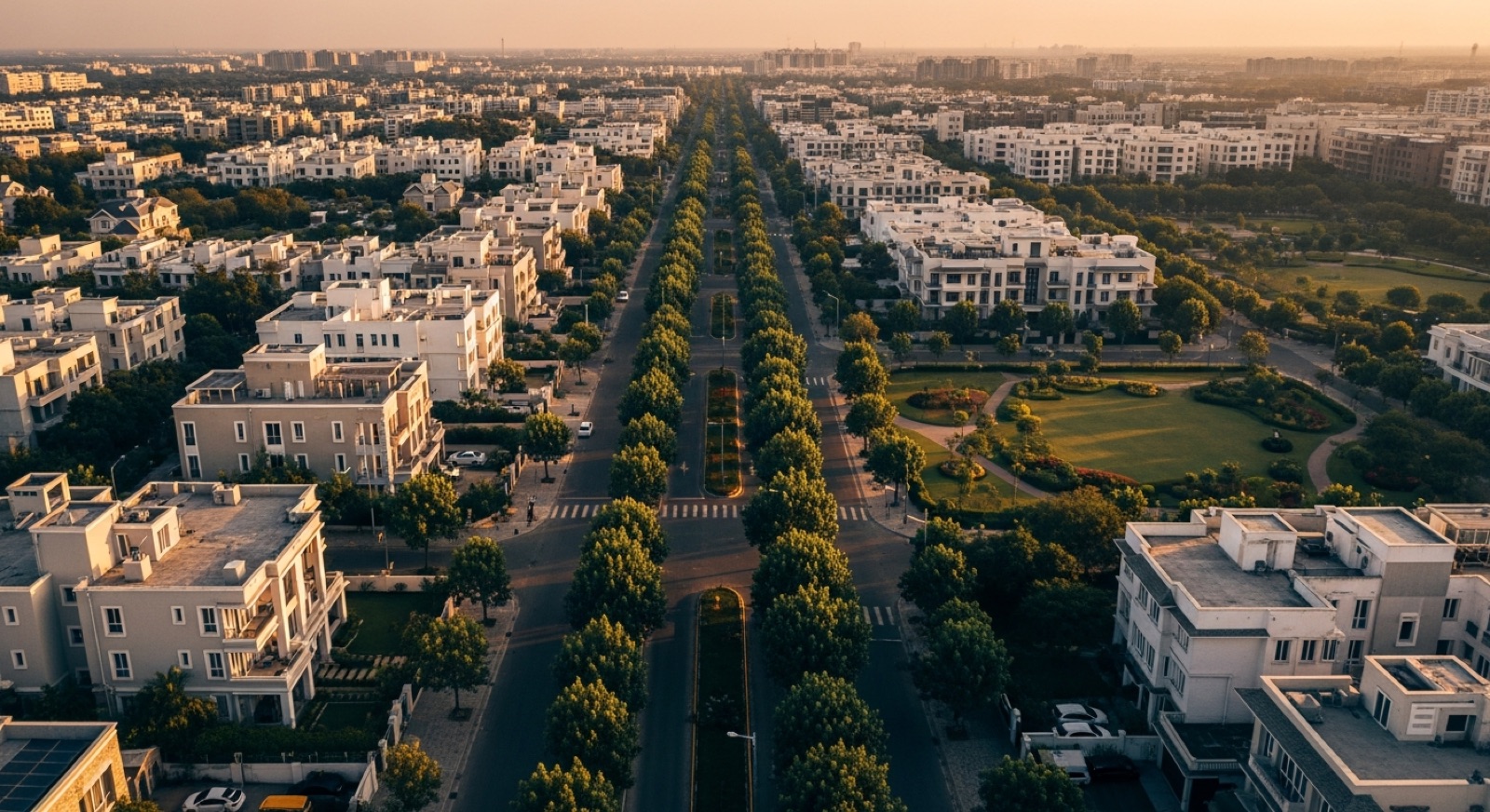
Living in Kharghar, Navi Mumbai: The Complete Area & Buying Guide
Kharghar has quietly become one of Navi Mumbai's most sought-after residential nodes — a planned, green, well-connected suburb that offers space and calm at a fraction of island-city Mumbai prices, while sitting at the centre of the infrastructure boom reshaping the region. For home buyers weighing where to put down roots or invest in the Mumbai Metropolitan Region (MMR), Kharghar keeps coming up, and for good reason: it combines CIDCO's orderly planning, genuine open space, strong rail and road links, and a pipeline of connectivity projects — the Navi Mumbai International Airport, the Atal Setu sea link, and the Navi Mumbai Metro — that are steadily pulling it closer to the rest of the city.
This guide is a practical, honest look at living in and buying property in Kharghar: where it sits and how it is laid out, its connectivity today and tomorrow, the social infrastructure that makes daily life work, who the node suits, the investment case, and the specific things to check before you buy. Property prices move constantly, so rather than quote figures that quickly go stale, this guide focuses on the durable factors that drive value — and points you to tools and verified listings to check current numbers yourself.
Where Kharghar is, and how it is planned
Kharghar is a node of Navi Mumbai, the planned satellite city developed by CIDCO (the City and Industrial Development Corporation) to decongest Mumbai. It lies along the Sion–Panvel corridor, on the Harbour rail line towards Panvel, and is organised — like the rest of Navi Mumbai — into numbered sectors, each with its own residential pockets, markets and amenities.
That planned origin is a big part of Kharghar's appeal. Unlike organically-grown, congested parts of older Mumbai, Kharghar was laid out with wide roads, defined sectors, reserved open spaces and civic amenities from the start. The result is a suburb that feels more spacious and breathable than most of the MMR, with tree-lined avenues, hills as a backdrop, and room to walk and cycle that is rare closer to the city.
The sector system
Because Kharghar is organised into sectors, the specific sector matters a great deal to your daily experience — proximity to the station, to a good market, to schools, and the character of the immediate pocket can vary from one sector to the next. When you shortlist a home, evaluate the sector, not just the node: walk it, check the walk to the station and to daily conveniences, and see how the immediate surroundings feel at different times of day.
Explore verified homes in Kharghar
Being Real Estate lists RERA-checked, owner-verified properties across Navi Mumbai with real photos and honest details.
Connectivity: today and the game-changing pipeline
Connectivity is where Kharghar's story gets genuinely exciting, because it is good today and improving fast.
Rail
Kharghar sits on the Harbour Line with its own railway station, linking it towards Panvel on one side and towards Vashi, Nerul, and onward to Mumbai on the other. Suburban rail remains the backbone of MMR commuting, and having a station within the node is a core convenience.
Road
The Sion–Panvel Expressway runs alongside, giving fast road access towards Mumbai and towards Pune via the old and new expressway networks. Kharghar's wide internal roads and organised layout make driving and parking far easier than in older suburbs.
Metro
The Navi Mumbai Metro has brought urban rapid transit to the corridor, with the network serving the Belapur–Kharghar–Pendhar stretch and further phases planned. Metro access adds a fast, reliable layer of intra–Navi Mumbai connectivity that strengthens Kharghar's position as a self-contained place to live and work.
The Navi Mumbai International Airport
The upcoming Navi Mumbai International Airport, in the Panvel area close to Kharghar, is one of the single biggest long-term value drivers for the whole node. Proximity to a major new airport typically lifts both residential demand and commercial activity, and Kharghar is well placed to benefit as the airport and its surrounding economic zone develop.
The Atal Setu (Mumbai Trans Harbour Link)
The Atal Setu / Mumbai Trans Harbour Link (MTHL) — the long sea bridge connecting Mumbai's Sewri side to the Navi Mumbai mainland near Nhava Sheva — dramatically shortens travel time between South Mumbai and the Navi Mumbai side. For Kharghar, better access towards Mumbai's employment cores strengthens the case for living here while working across the harbour.
Taken together, this pipeline — airport, sea link, metro — is why so many buyers and investors view Kharghar as a node whose connectivity, and therefore desirability, is on a rising trajectory rather than a static one.
Social infrastructure: what daily life looks like
A node can be well-connected and still be an unpleasant place to live if the everyday infrastructure is thin. Kharghar scores well here.
Open space and recreation
Kharghar is unusually green for the MMR. It is known for its large Central Park, one of the biggest urban parks in the region, and for the Kharghar Golf Course set against the hills. The Pandavkada hills and waterfall area, the hillside ISKCON temple, and open valleys give residents genuine access to nature — a quality-of-life advantage that is hard to find and hard to replicate closer to the city.
Education
The node and its surroundings host a range of schools and higher-education and medical institutions, which is part of why families are drawn here. Established educational infrastructure is both a daily convenience and a long-term demand driver, because families anchor around good schooling.
Healthcare
Kharghar and neighbouring nodes have hospitals and specialty medical facilities, including well-known institutions in the wider area, giving residents access to healthcare without travelling into Mumbai.
Retail and daily needs
Sector markets, malls, supermarkets, restaurants and everyday retail are well distributed, so daily life does not require long trips. The planned layout means most sectors have convenient access to the essentials.
Work out the numbers for a Kharghar home
Estimate your EMI, stamp duty in Maharashtra, and whether buying beats renting here.
Who Kharghar suits
- Families who want space, greenery, schools and a calmer environment than inner Mumbai, without leaving the MMR.
- Professionals working in Navi Mumbai's business districts (such as Belapur and the wider CBD), or willing to commute towards Mumbai via rail and the sea link.
- First-time buyers priced out of island-city and near-suburb Mumbai, seeking better value per square foot in a planned setting.
- Investors and NRIs looking for a node with strong infrastructure tailwinds — airport, metro, sea link — and steady rental demand from students, professionals and families.
The investment case for Kharghar
Kharghar's investment appeal rests on a few durable pillars rather than on speculation:
- Infrastructure tailwinds: the airport, metro and sea link are the kind of structural improvements that historically support long-run demand and price growth in well-located nodes.
- Planned scarcity of quality: Kharghar's green, planned character is genuinely differentiated within the MMR, and quality supply of that kind is not infinite.
- Rental demand: a mix of students, healthcare and IT professionals, and families supports a steady rental market, which matters for investors and for exit liquidity.
- Relative value: compared with equivalent space closer to Mumbai's core, Kharghar offers more home for the money, which sustains end-user demand.
As with any investment, none of this guarantees returns, and timing, the specific project, and the price you pay all matter. Use realistic rental and appreciation assumptions, and buy on the fundamentals — location within the node, connectivity, and a clean, RERA-registered project — rather than on hype.
What to check before you buy in Kharghar
Kharghar is a strong node, but due diligence still applies to every individual purchase.
- RERA registration: for any under-construction or new-launch project, verify the RERA number on the MahaRERA portal and read the full project record before committing.
- The specific sector and micro-location: check the real walk to the station, market and schools, and how the immediate pocket feels. Some sectors are more convenient or more premium than others.
- Developer track record: confirm the promoter's delivery history, especially for under-construction homes.
- Low-lying areas and monsoon: parts of Navi Mumbai can be low-lying; ask about drainage and any monsoon water-logging history for the specific location.
- Water supply and society health: for ready flats, check water supply reliability, maintenance dues, and the society's condition.
- Title and occupancy certificate: confirm clean title, an encumbrance check, and the OC for a completed building.
Kharghar compared with its neighbours
Kharghar sits among several Navi Mumbai and Panvel-corridor nodes, and it helps to see it in context:
- Kharghar leads on greenery, planned character and social infrastructure, and tends to sit at a premium to the newer, further-out nodes for those reasons.
- Panvel is a larger, older hub closer to the airport with its own rail connectivity and a range of price points.
- Kamothe and Kalamboli offer value along the same corridor, generally at lower entry prices, with their own trade-offs on ambience and infrastructure maturity.
- Ulwe and the Dronagiri side are newer, airport-adjacent growth nodes with a more emerging feel and a longer-horizon investment profile.
If your priority is a settled, green, family-friendly environment with mature amenities, Kharghar is often the pick; if you are chasing the lowest entry price or the most airport-adjacent speculative upside, a neighbouring node may fit better. Match the node to your goal.
Practical tips for buying in Kharghar
- Shortlist by sector, then by project — decide which pockets suit your commute and lifestyle before comparing individual buildings.
- Visit at different times — a weekday morning commute and a weekend evening tell you very different, useful things about a location.
- Compare on carpet area and price per carpet square foot, not headline super built-up numbers.
- Verify RERA and title independently — do not rely on the seller's assurances alone.
- Run the full cost — EMI, down payment, stamp duty and registration, GST if under-construction, and interiors — before you commit.
- Think about exit and rental from day one, even if you are buying to live, because it protects your investment.
The bottom line on Kharghar
Kharghar offers something increasingly rare in the Mumbai region: a planned, green, well-connected place to live at a price that still makes sense, sitting squarely in the path of the infrastructure that is reshaping Navi Mumbai. For families it delivers space and quality of life; for professionals it balances calm with connectivity; for investors it offers structural tailwinds and steady demand. The node earns its popularity — but a good purchase still comes down to the specific sector, a clean RERA-registered project, an honest price on carpet area, and proper due diligence. Get those right, and Kharghar is one of the more compelling places to buy a home in the MMR today.
A crucial Navi Mumbai nuance: CIDCO, leasehold and transfer
One consideration is specific to Navi Mumbai and often surprises buyers coming from other cities: much of the land here was developed by CIDCO, and many properties historically sat on leasehold land rather than freehold, with transfers requiring CIDCO processes. This has real, practical implications you should understand before buying.
- Leasehold vs freehold: confirm the tenure of the specific property. Leasehold does not make a property un-buyable — a large share of Navi Mumbai homes trade on it — but it affects the transfer process and sometimes financing, so know what you are buying.
- Transfer charges and CIDCO NOC: resale of certain CIDCO properties can involve a transfer/permission process and charges, and a no-objection certificate. Factor any such cost and timeline into your purchase, and have your lawyer confirm the exact requirements for that property.
- Documentation trail: ensure the chain of allotment, transfers and any CIDCO approvals is complete and clean. Gaps here can complicate both your purchase and your future resale.
None of this is a reason to avoid Kharghar — it is simply a local layer of diligence. A good local lawyer who regularly handles Navi Mumbai transactions will navigate it routinely, and clarifying it up front prevents surprises at registration or at your eventual exit.
The rental market in Kharghar
For investors, and for buyers thinking about future flexibility, Kharghar's rental market is a genuine strength driven by a diverse tenant base.
- Students and young professionals drawn by the node's educational and medical institutions and its connectivity.
- Families who want the space, schools and green environment but are not yet ready to buy.
- Professionals working across Navi Mumbai's business districts or commuting towards Mumbai.
This mix supports steady occupancy and a range of rental price points across configurations. If you are buying to let, evaluate the specific sector's rental demand, the configuration most in demand there (compact units often rent fastest), and realistic yields based on current rents — use a valuation and rent check rather than assumptions. Steady rental demand also matters for owner-occupiers, because it underpins resale liquidity if your plans change.
Commute scenarios: what daily travel really looks like
Where you work shapes whether Kharghar fits, so think in concrete commute terms:
- Working within Navi Mumbai (Belapur CBD, the corporate parks, or the airport economic zone as it grows): Kharghar is well placed, with short rail, metro and road options — arguably its strongest use case.
- Commuting towards Mumbai: the Harbour Line and, increasingly, the Atal Setu sea link make this workable, though travel time to South Mumbai or the western suburbs is still a real consideration. Test your specific route at peak times before committing.
- Towards Pune: the expressway network makes weekend or periodic Pune trips convenient, a bonus for many MMR households.
- To the airport: proximity to the upcoming Navi Mumbai International Airport is a standout advantage for frequent flyers and for long-term value.
Cost of living and lifestyle
Beyond the price of the home, Kharghar tends to offer a comfortable cost of living relative to inner Mumbai. Space is more affordable, daily needs are well served by sector markets and malls, and the abundance of open space and recreation — parks, hills, the golf course — adds quality of life that does not show up on a price sheet but matters enormously day to day. For families in particular, the combination of space, greenery, schooling and community is the core of Kharghar's appeal, and it is why many residents who move here stay.
Future outlook
The medium-term outlook for Kharghar is closely tied to the region's infrastructure trajectory. As the Navi Mumbai International Airport progresses, the metro network matures, and the Atal Setu embeds better Mumbai connectivity, the node's accessibility and economic gravity are set to strengthen. Growth of this kind tends to support both end-user demand and investor interest over time. The sensible way to read this is not as a promise of guaranteed appreciation, but as a set of structural tailwinds that make Kharghar a node with genuine long-term fundamentals — provided you buy a sound, RERA-registered property at a fair price.
Kharghar pros and cons at a glance
| Strengths | Things to weigh |
|---|---|
| Planned, green, spacious environment | Commute to central/western Mumbai still takes time |
| Strong rail, metro and road connectivity | Some low-lying pockets — check monsoon drainage |
| Major infrastructure tailwinds (airport, sea link, metro) | CIDCO leasehold/transfer nuances to verify |
| Good schools, healthcare, parks and retail | Premium to some neighbouring value nodes |
| Better value per sq ft than inner Mumbai | Sector-to-sector quality varies — location within the node matters |
A Navi Mumbai-specific buying process
- Pick your sector based on commute, schools and the feel of the pocket.
- Shortlist RERA-registered projects (or, for resale, confirm approvals and OC) and verify on MahaRERA.
- Confirm tenure — leasehold or freehold — and any CIDCO transfer requirements and charges.
- Do independent title and encumbrance checks through a lawyer familiar with Navi Mumbai.
- Compare on carpet area and price per carpet square foot across your shortlist.
- Run the full cost — EMI, down payment, stamp duty, registration, GST if under-construction, transfer charges, and interiors.
- Register the sale deed with correct stamp duty, and complete any CIDCO formalities.
Ready to find your home in Kharghar?
Browse verified, RERA-checked Kharghar listings with real photos and transparent pricing on Being Real Estate.
Frequently asked questions
Is Kharghar a good place to live in Navi Mumbai?+
Yes, Kharghar is one of Navi Mumbai's most popular residential nodes thanks to its planned, green layout, wide roads, strong social infrastructure (schools, hospitals, Central Park, golf course) and good rail and road connectivity. It offers more space and value than inner Mumbai while benefiting from major upcoming infrastructure.
How well connected is Kharghar?+
Kharghar has its own Harbour Line railway station, sits on the Sion-Panvel Expressway, and is served by the Navi Mumbai Metro. Connectivity is set to improve further with the Navi Mumbai International Airport nearby and the Atal Setu (Mumbai Trans Harbour Link) shortening travel to Mumbai.
Is Kharghar a good investment?+
Kharghar's investment case rests on strong infrastructure tailwinds (airport, metro, sea link), its differentiated planned-and-green character, steady rental demand, and relative value versus inner Mumbai. As always, returns depend on the specific project, timing and price, so buy on fundamentals and a clean RERA-registered project.
What should I check before buying a flat in Kharghar?+
Verify the project's RERA registration on MahaRERA, evaluate the specific sector and the real walk to the station and amenities, confirm the developer's track record, compare on carpet area, check title and the occupancy certificate, and ask about monsoon drainage and water supply for the exact location.
How does Kharghar compare with Panvel, Kamothe and Ulwe?+
Kharghar leads on greenery, planned character and mature social infrastructure and usually sits at a premium. Panvel is a larger, airport-adjacent hub; Kamothe and Kalamboli offer lower entry prices; Ulwe and Dronagiri are newer airport-adjacent growth nodes with a longer-horizon profile. Match the node to your goal.
Keep reading
 Location Guide
Navi Mumbai Airport & Property: How to Invest Around the Catalyst (2026)
How the new airport affects Navi Mumbai property — why it matters, which nodes are affected, how infrastructure-led growth really works, the investment case and risks, and how to buy sensibly.
 Location Guide
Living in Whitefield, Bangalore: Tech Parks, Metro & Property Guide (2026)
A practical guide to living in and buying property in Whitefield, Bengaluru — tech parks, the metro, lifestyle, who it suits, the investment case, and what to check before you buy.
 Location Guide
Living in Wakad, Pune: Hinjewadi Proximity, Lifestyle & Property Guide (2026)
A practical guide to living in and buying property in Wakad, Pune — Hinjewadi proximity, connectivity, lifestyle, who it suits, the investment case, and what to check before you buy.