
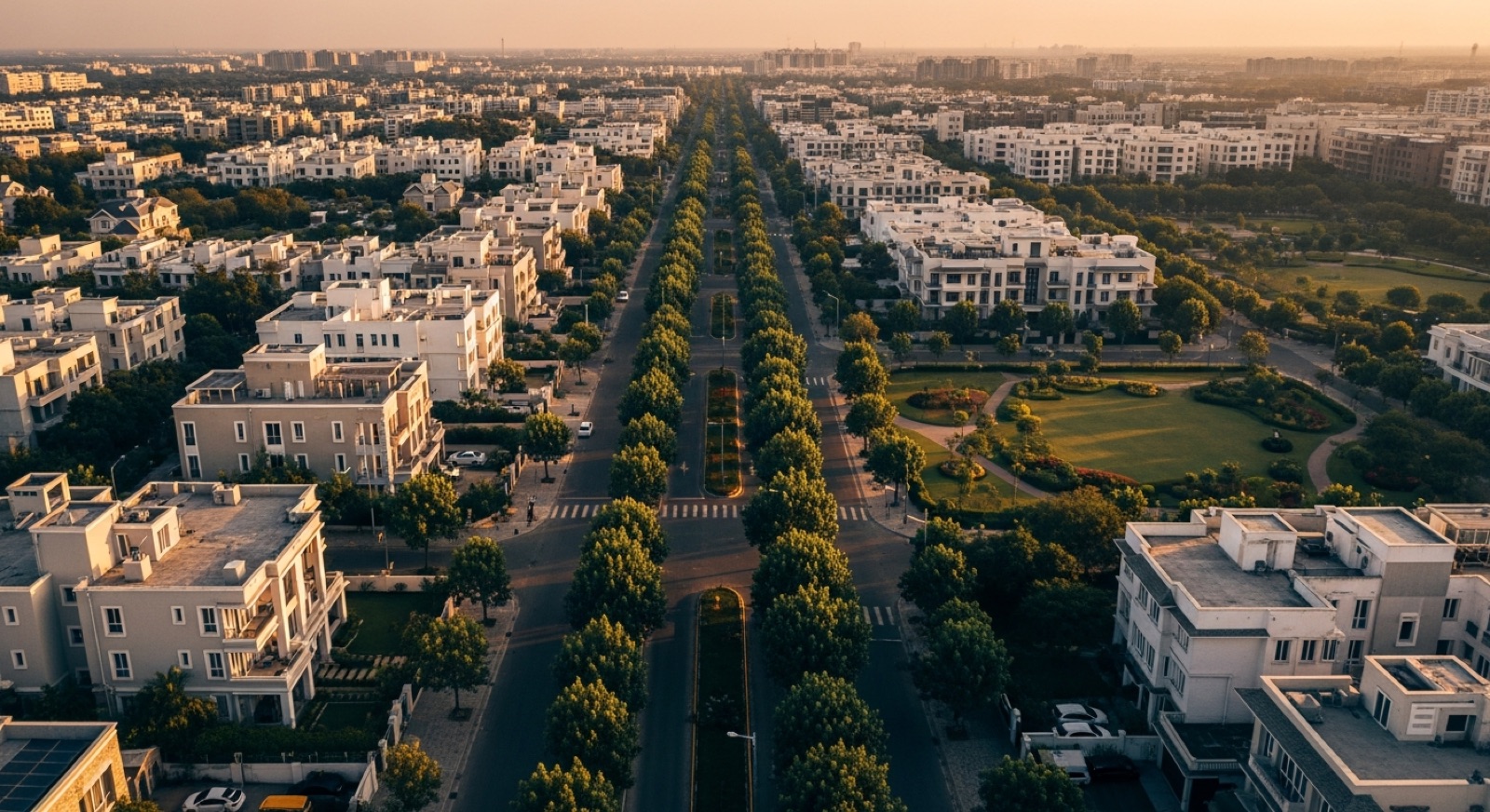
Living in Panvel: The Complete Area & Investment Guide
Few locations in the Mumbai Metropolitan Region have as much structural momentum behind them as Panvel. Sitting at the southern gateway of Navi Mumbai, Panvel is where the region's biggest infrastructure bets converge — the Navi Mumbai International Airport on its doorstep, the Atal Setu sea link connecting it towards Mumbai, a major railway junction, and expressways running to both Mumbai and Pune. For buyers and investors looking for affordability today with a credible long-term growth story, Panvel is one of the MMR's most talked-about destinations.
This guide takes a practical, honest look at living in and buying property in Panvel: where it sits, its exceptional connectivity, the airport-driven investment case, its social infrastructure, who it suits, and what to check before you buy. Because prices move quickly in high-growth corridors, this guide focuses on the durable drivers of value rather than figures that go stale — and points you to verified listings and tools to check current numbers.
Where Panvel sits
Panvel lies in the Raigad district at the southern end of the Navi Mumbai region, and is served by the Panvel Municipal Corporation, one of the region's newer and larger civic bodies. It combines an older, established town (Old Panvel) with planned, CIDCO-developed nodes (New Panvel) and a growing belt of townships and residential development. This mix gives buyers a wide range of options, from established neighbourhoods to newer gated communities.
Its position is the key to its story: Panvel is the meeting point of Navi Mumbai, the Mumbai-Pune corridor, and the Konkan region, which is precisely why so much transport infrastructure runs through or terminates here.
Explore verified homes in Panvel
Being Real Estate lists RERA-checked, owner-verified properties across the Panvel and Navi Mumbai belt.
Connectivity: the strongest in the region's south
Rail
Panvel Junction is a major railway node — a hub for the Harbour line, the Konkan Railway, and suburban and outstation services. This gives residents extensive rail connectivity towards Mumbai, Navi Mumbai and the Konkan coast, and makes Panvel a genuine transport gateway rather than an end-of-the-line suburb.
Road
Panvel is exceptionally well connected by road: the Mumbai-Pune Expressway and old highway, the Sion-Panvel Expressway, and the roads towards the Konkan all pass through or near it. Major proposed corridors, including regional multimodal links, are set to strengthen this further.
The Atal Setu sea link
The Atal Setu / Mumbai Trans Harbour Link lands on the Navi Mumbai mainland near the Panvel side, dramatically shortening travel between Mumbai and this belt. Improved access towards Mumbai's employment cores is a major boost for Panvel's residential appeal.
The Navi Mumbai International Airport
The single biggest factor is the Navi Mumbai International Airport, located in the Panvel area. A major international airport transforms the economics of its surroundings — driving jobs, commercial activity, hospitality and residential demand. Panvel's proximity puts it at the centre of this transformation, which is the core of its long-term investment case.
The airport-driven investment case
Panvel's investment story is unusually concrete for a growth corridor, because it rests on committed, large-scale infrastructure rather than speculation alone:
- Airport catchment: proximity to a new international airport historically supports sustained residential and commercial demand and price growth over time.
- Multi-modal connectivity: rail junction, expressways and the sea link give Panvel access in every direction.
- Affordability with headroom: entry prices remain accessible relative to established Navi Mumbai nodes, leaving room to grow from a lower base.
- Employment and commercial growth: the airport economic zone and surrounding development are expected to create local jobs, deepening end-user demand.
None of this guarantees returns — timelines for large infrastructure evolve, and the price you pay and the specific project matter enormously. But few MMR locations combine affordability with this density of structural tailwinds.
Weigh the numbers before you invest
Estimate EMIs, Maharashtra stamp duty, and rental-vs-buy math for a Panvel home.
Social infrastructure and daily life
- Education: Panvel and the surrounding nodes have a range of schools and colleges, supporting family living.
- Healthcare: hospitals and clinics serve the local population, with more facilities across Navi Mumbai.
- Retail: established markets in Old Panvel plus newer malls and retail in developing pockets cover daily and lifestyle needs.
- Township amenities: newer gated developments add clubhouses, gyms, gardens and security.
As with any fast-developing area, infrastructure maturity varies by pocket — established parts are fully serviced, while newer belts are still filling in amenities. Evaluate the specific location, not just the town.
Who Panvel suits
- Value-focused first-time buyers who want ownership in the MMR at an accessible price.
- Investors seeking a credible, infrastructure-backed growth story — especially the airport catchment.
- Commuters and professionals who value the exceptional multi-directional connectivity.
- Families wanting township living with room and amenities.
What to check before you buy in Panvel
- RERA registration verified on MahaRERA for any under-construction or new-launch project.
- Developer track record and the specific township phase.
- CIDCO/leasehold nuances — as elsewhere in Navi Mumbai, confirm tenure and any transfer requirements with a local lawyer.
- Infrastructure timelines: value the home on today's connectivity, treating future airport/corridor milestones as upside, not certainty you overpay for now.
- Low-lying areas and drainage: parts of the belt can be low-lying; ask about monsoon water-logging for the exact location.
- Title, OC and dues confirmed through independent checks.
Panvel compared with its neighbours
- Panvel leads on connectivity and airport proximity, with a broad range of price points from Old Panvel to newer townships.
- Kharghar is the greener, more premium, established node to the north — a step up in ambience and price.
- Kalamboli and Kamothe offer value along the same belt with their own trade-offs.
- Ulwe and Dronagiri are newer, airport-adjacent growth nodes with a more emerging, longer-horizon profile.
If your priority is the strongest connectivity and the most direct airport-growth exposure at an accessible price, Panvel is a compelling pick; if you want a greener, more settled environment and can pay more, Kharghar is the step up.
A practical buying process for Panvel
- Decide the pocket — Old Panvel, a CIDCO node, or a newer township — based on your budget and lifestyle.
- Shortlist RERA-registered projects and verify on MahaRERA; confirm phase and developer.
- Confirm tenure and any CIDCO transfer requirements.
- Do independent title and encumbrance checks through a local lawyer.
- Compare on carpet area and price per carpet square foot.
- Run the full cost — EMI, down payment, stamp duty, registration, GST if under-construction, and interiors.
- Register properly and complete mutation afterwards.
The bottom line on Panvel
Panvel offers a rare combination in the MMR: genuine affordability today, exceptional multi-directional connectivity, and the single largest infrastructure catalyst in the region — a new international airport — on its doorstep. For value buyers and infrastructure-minded investors, that is a powerful proposition. As always, the quality of your specific purchase — a clean, RERA-registered project, an honest carpet-area price, a well-chosen pocket, and proper due diligence — is what turns Panvel's strong fundamentals into a genuinely good buy.
The rental market in Panvel
Panvel's rental market is supported by its transport-hub status and a growing local economy. Tenants include commuters who value the junction and expressway access, workers linked to the area's commercial and (increasingly) airport-related activity, and families wanting township amenities before buying. As the airport and its economic zone develop, rental demand from airport and logistics employment is expected to deepen. For investors, this points to steady occupancy and improving prospects; evaluate the specific pocket's demand and realistic yields using current rents rather than assumptions.
Commute scenarios
- To Mumbai: rail via the junction and road via the Sion-Panvel Expressway and Atal Setu; longer than from inner nodes, but improving with the sea link.
- To Pune: direct access via the Mumbai-Pune Expressway makes Pune trips convenient.
- To the airport: proximity to the Navi Mumbai International Airport is a standout for frequent flyers and airport-linked work.
- Within Navi Mumbai: good links to Kharghar, Belapur and the CBD for those living and working in the region.
Cost of living and lifestyle
Panvel offers an affordable cost of living relative to nodes closer to Mumbai. Housing is accessible, established markets and newer retail cover daily needs, and township developments add lifestyle amenities. The trade-off is that some newer belts are still maturing, so you exchange a little present-day polish for value and a strong growth trajectory. For value-focused families and first-time buyers, that trade is often worth it.
Future outlook
Panvel's medium-term outlook is among the strongest in the MMR, anchored by committed infrastructure: the airport becoming operational and scaling, the Atal Setu embedding better Mumbai access, and regional corridors improving connectivity further. These are structural, capacity-changing upgrades that historically support both end-user demand and appreciation from an affordable base. The prudent reading is not guaranteed gains, but a dense set of tailwinds that give Panvel genuine long-term fundamentals — provided you buy a sound, RERA-registered home at a fair price and value it on today's connectivity.
Panvel pros and cons at a glance
| Strengths | Things to weigh |
|---|---|
| Direct airport-growth exposure | Some infrastructure is still being delivered |
| Exceptional multi-directional connectivity | Commute to central Mumbai still takes time |
| Strong affordability with headroom | Newer belts still maturing on amenities |
| Broad range of options (Old Panvel to townships) | CIDCO/leasehold tenure nuances to verify |
| Deepening rental demand | Some low-lying pockets — check drainage |
Ready to find your home in Panvel?
Browse verified, RERA-checked Panvel listings with real photos and transparent pricing on Being Real Estate.
Frequently asked questions
Is Panvel a good place to invest in property?+
Panvel has an unusually concrete investment case built on committed infrastructure — the Navi Mumbai International Airport on its doorstep, the Atal Setu sea link, a major railway junction, and expressways to Mumbai and Pune — combined with affordability that leaves room to grow. As always, returns depend on the specific project, price and timing, so buy on fundamentals and a clean RERA-registered project.
How is connectivity from Panvel?+
Excellent and multi-directional. Panvel Junction is a major railway hub (Harbour line, Konkan Railway, suburban and outstation), and the town is served by the Mumbai-Pune and Sion-Panvel expressways. The Atal Setu shortens travel towards Mumbai, and the Navi Mumbai International Airport is nearby.
How does the Navi Mumbai airport affect Panvel?+
The Navi Mumbai International Airport is located in the Panvel area and is the single biggest driver of the town's long-term value. A major international airport typically boosts jobs, commercial activity and residential demand in its catchment, placing Panvel at the centre of that growth.
What should I check before buying in Panvel?+
Verify the project's RERA registration on MahaRERA, confirm the developer's track record and township phase, check CIDCO/leasehold tenure and any transfer requirements with a local lawyer, value the home on today's connectivity, confirm title and the occupancy certificate, and ask about monsoon drainage for the exact location.
How does Panvel compare with Kharghar?+
Panvel leads on connectivity and direct airport-growth exposure with a broad range of price points and strong affordability. Kharghar is the greener, more premium and more established node to the north, a step up in ambience and price. Choose Panvel for value and airport upside, Kharghar for a settled, green environment.
Keep reading
 Location Guide
Navi Mumbai Airport & Property: How to Invest Around the Catalyst (2026)
How the new airport affects Navi Mumbai property — why it matters, which nodes are affected, how infrastructure-led growth really works, the investment case and risks, and how to buy sensibly.
 Location Guide
Living in Whitefield, Bangalore: Tech Parks, Metro & Property Guide (2026)
A practical guide to living in and buying property in Whitefield, Bengaluru — tech parks, the metro, lifestyle, who it suits, the investment case, and what to check before you buy.
 Location Guide
Living in Wakad, Pune: Hinjewadi Proximity, Lifestyle & Property Guide (2026)
A practical guide to living in and buying property in Wakad, Pune — Hinjewadi proximity, connectivity, lifestyle, who it suits, the investment case, and what to check before you buy.